Vietnam Cassava Starch Factory Installs Four 2.5-Meter Belt Filter Presses for Cassava Residue Dewatering
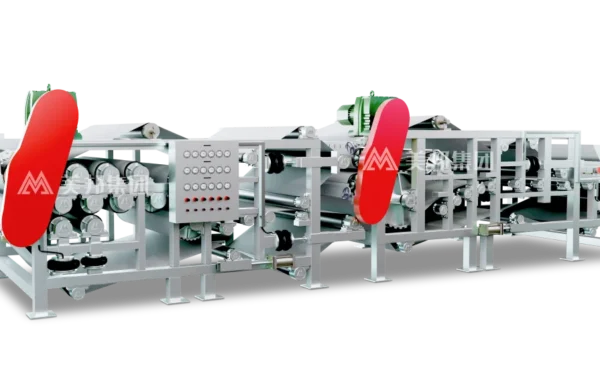
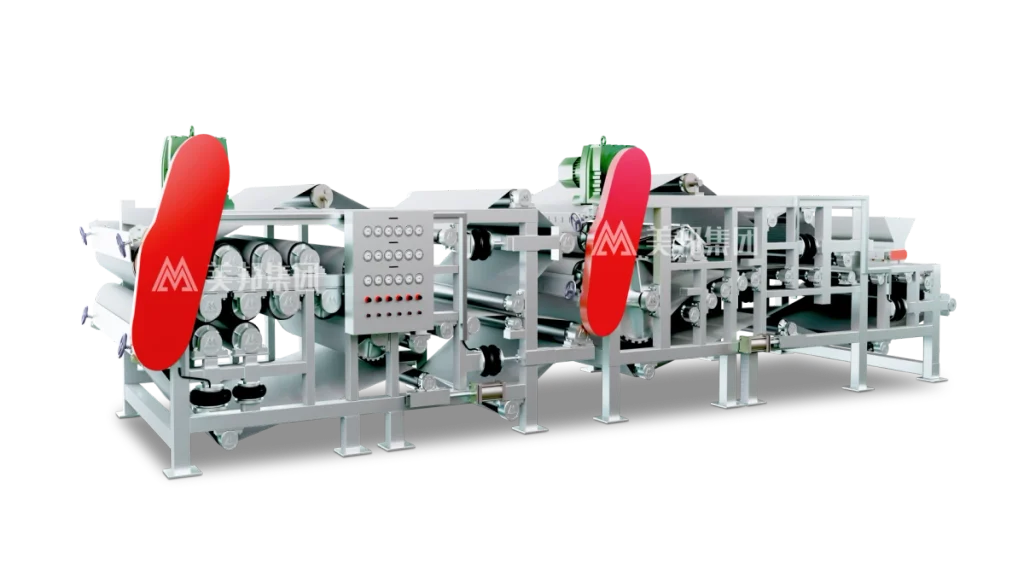
A large cassava starch factory in Vietnam has installed four 2.5-meter belt filter presses from Meibang for continuous cassava residue dewatering. The project was developed to handle the large volume of wet cassava residue generated during starch production and to provide a reliable mechanical dewatering solution for the factory’s daily operation.
Cassava residue is produced in large quantities during starch extraction. Fresh residue contains a high amount of water, making it difficult and expensive to transport, store, or dry directly. For a large starch factory, efficient water removal is therefore an important part of the overall residue handling process.
In this project, four large belt filter presses work together to provide a total processing capacity of up to 40 m³/h.
Project Overview
The Vietnamese customer operates a large-scale cassava starch processing factory where cassava residue is continuously generated as a by-product of starch extraction.
After comparing equipment and processing solutions, the customer selected four Meibang 2.5-meter belt filter presses for the cassava residue dewatering system.
Each belt press has a processing capacity of approximately 8–10 m³/h of wet cassava residue. With four machines operating for around 20 hours per day, the system can theoretically handle up to 800 m³ of wet cassava residue per day.
Based on a typical bulk density of cassava residue, this volume corresponds to approximately 270–280 tons of wet cassava residue per day.
The project therefore represents a substantial cassava residue dewatering application rather than a small-scale processing system.
Main Equipment Configuration
- Equipment: Belt filter press
- Application: Cassava residue dewatering
- Belt width: 2.5 meters
- Number of machines: 4 units
- Capacity per machine: 8–10 m³/h
- Combined capacity: Up to 40 m³/h
- Operating time: Approximately 20 hours/day
- Maximum daily volume: Up to 800 m³/day
- Estimated wet residue throughput: Approximately 270–280 tons/day
Actual capacity can vary according to the moisture content, fiber characteristics, bulk density, feeding conditions, and operating parameters of the cassava residue.
Why Cassava Residue Requires Efficient Dewatering
Cassava residue is mainly composed of fibrous material remaining after starch has been extracted from cassava roots. Although the material contains useful organic matter and can be further utilized, its high moisture content creates challenges for handling.
Moving large quantities of wet residue requires more transportation capacity. Wet material can also occupy considerable storage space and can deteriorate if it remains untreated for extended periods.
Drying is another major consideration.
If wet cassava residue is sent directly into a thermal dryer, the dryer must remove a large quantity of water before the material reaches the required final moisture content. This increases the thermal load and can make the overall drying process less economical.
Mechanical dewatering provides a practical solution before drying.
Instead of relying entirely on thermal energy to remove water, a cassava residue dewatering machine can first remove a substantial portion of free water through mechanical pressure and filtration. The dewatered residue can then be sent to a dryer or another downstream processing system.
For a large cassava starch factory, this difference becomes significant because the amount of residue generated every day can reach hundreds of tons.
Four 2.5-Meter Belt Filter Presses Working Together
The scale of this project is one of its key features.
A single small dewatering machine may be suitable for a limited amount of cassava residue, but a large starch factory requires equipment capable of continuous high-volume processing.
The four 2.5-meter belt filter presses supplied for this project provide a combined nominal processing capacity of up to 40 m³/h.
Each machine processes approximately 8–10 m³ of wet cassava residue per hour. When operating for 20 hours per day, one machine can theoretically process up to 160–200 m³ of material per day.
Four machines therefore provide a maximum theoretical volume of:
10 m³/h × 20 hours × 4 machines = 800 m³/day
Using a typical bulk density for cassava residue, this is equivalent to approximately 270–280 tons of wet residue per day.
The actual operating capacity depends on the material entering the machine. Cassava residue can vary considerably between factories depending on cassava variety, starch extraction efficiency, washing conditions, fiber content, moisture content, and upstream separation equipment.
For this reason, belt press capacity should always be selected according to actual material characteristics rather than relying only on the raw cassava processing capacity of a factory.
How a Belt Press Dewaters Cassava Residue
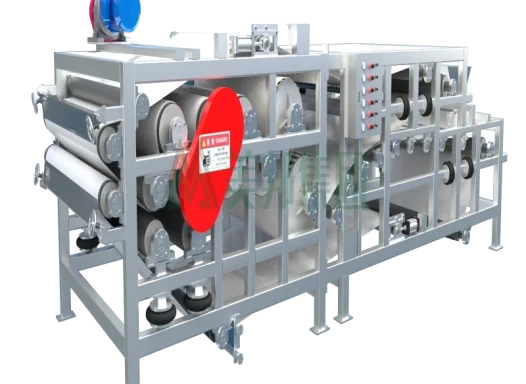
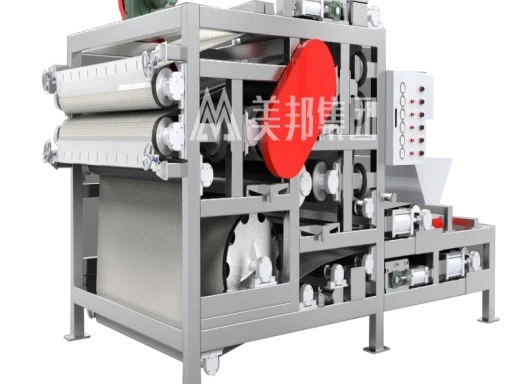
A belt filter press, also commonly called a belt press, continuously separates water from wet material through a combination of gravity drainage, belt filtration, mechanical pressure, and progressive compression.
Wet cassava residue enters the dewatering system and is distributed across the moving filter belt. Free water drains through the belt during the initial gravity dewatering stage.
The material then passes through different pressure zones as the two filter belts carry it through the machine. Gradually increasing pressure squeezes additional water from the residue while the fibrous solids are retained by the filter belts.
This continuous process makes a belt press particularly suitable for industrial applications where large quantities of wet material need to be processed every day.
Compared with batch-type equipment, continuous belt dewatering allows the machine to operate alongside the continuous production process of a cassava starch factory.
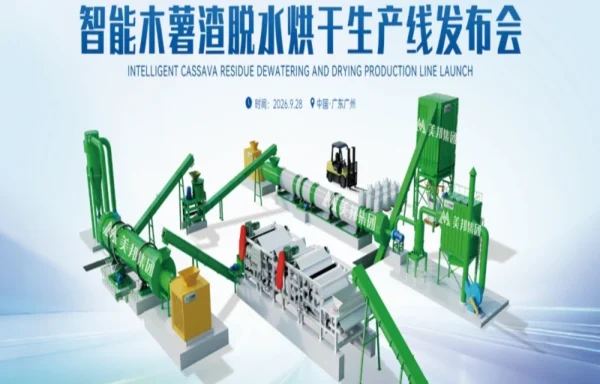
Mechanical Dewatering Before Drying
For cassava residue that needs to be dried, the belt press is not intended to replace the dryer. Instead, it works as the mechanical dewatering stage before thermal drying.
This combination is especially useful when the final product needs to have a much lower moisture content.
The basic concept is straightforward:
Wet cassava residue → Mechanical dewatering → Thermal drying → Final product
Mechanical dewatering removes water without heating the material. Thermal drying is then used to remove the remaining moisture to the required final level.
This approach can reduce the amount of water that the dryer needs to evaporate and can therefore help improve the efficiency of the complete cassava residue processing line.
For factories producing hundreds of tons of wet residue per day, even a moderate reduction in the moisture load entering the dryer can have a meaningful effect on the size and operating requirements of the downstream drying system.
A High-Capacity Solution for Cassava Processing Plants
The Vietnam project demonstrates why equipment capacity is an important consideration when selecting cassava residue dewatering equipment.
The factory does not simply need a machine that can remove water. It needs a system capable of keeping up with the continuous generation of cassava residue.
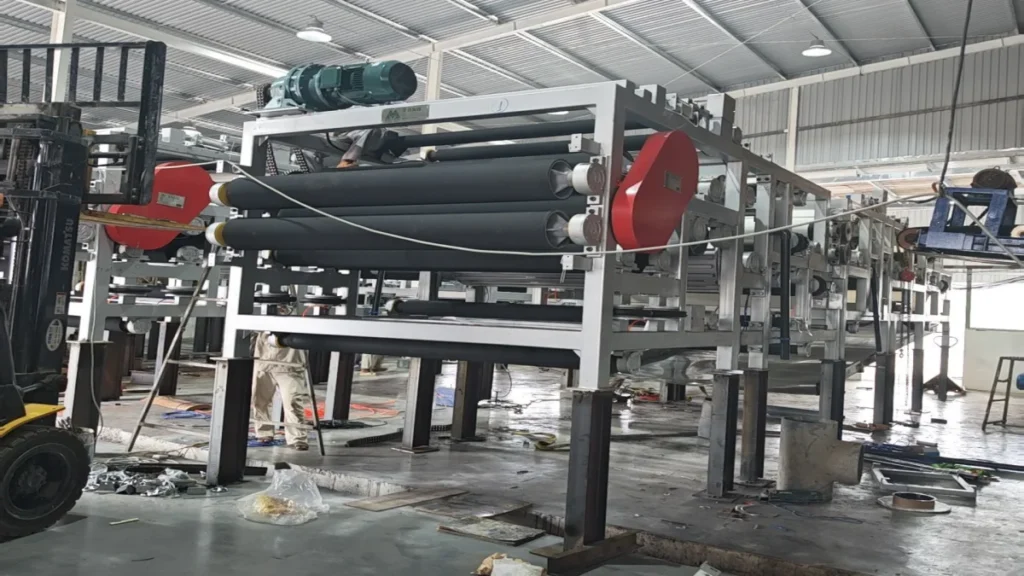
Four 2.5-meter belt presses provide multiple processing units instead of relying on a single machine. This configuration allows the factory to distribute the residue processing load across several machines and maintain continuous operation during long production periods.
The system can also be adjusted according to actual production requirements. Depending on the factory’s operating schedule and residue output, different numbers of machines can be operated at different times.
For large cassava processing plants, this flexibility is valuable because raw material supply and factory production can change during the cassava processing season.
From Waste Handling to Resource Recovery
Cassava residue is increasingly being considered not simply as waste, but as a potential resource.
After dewatering and, where necessary, drying, cassava residue can be used in applications such as animal feed, biomass fuel, organic fertilizer, and other forms of value-added processing, depending on its composition and local market requirements.
The first challenge is usually moisture.
Removing excess water makes the residue easier to handle and transport and creates better conditions for subsequent processing. In plants that use thermal drying, mechanical dewatering can also reduce the amount of water that must be removed by the dryer.
This is why a reliable cassava residue dewatering machine can play an important role in the overall economics of cassava starch production.
Meibang Belt Press for Cassava Residue Dewatering
This Vietnam project is a practical example of applying large-capacity belt press technology to cassava residue dewatering.
With four 2.5-meter belt filter presses, the system provides up to 40 m³/h of combined processing capacity. With 20 hours of daily operation, the theoretical maximum reaches 800 m³/day, equivalent to approximately 270–280 tons of wet cassava residue per day based on typical bulk density.
For cassava starch factories, the right equipment should be selected according to actual residue volume, moisture content, material characteristics, operating hours, and downstream requirements.
Meibang manufactures cassava residue dewatering machines, belt presses, and complete dewatering and drying solutions for cassava processing plants. Equipment capacity and configuration can be customized according to the customer’s material and production requirements.
If your cassava starch factory generates a large quantity of wet cassava residue and you are looking for a continuous mechanical dewatering solution, contact Meibang to discuss your material characteristics and processing capacity.