

Intelligent Cassava Residue Dewatering & Drying Line
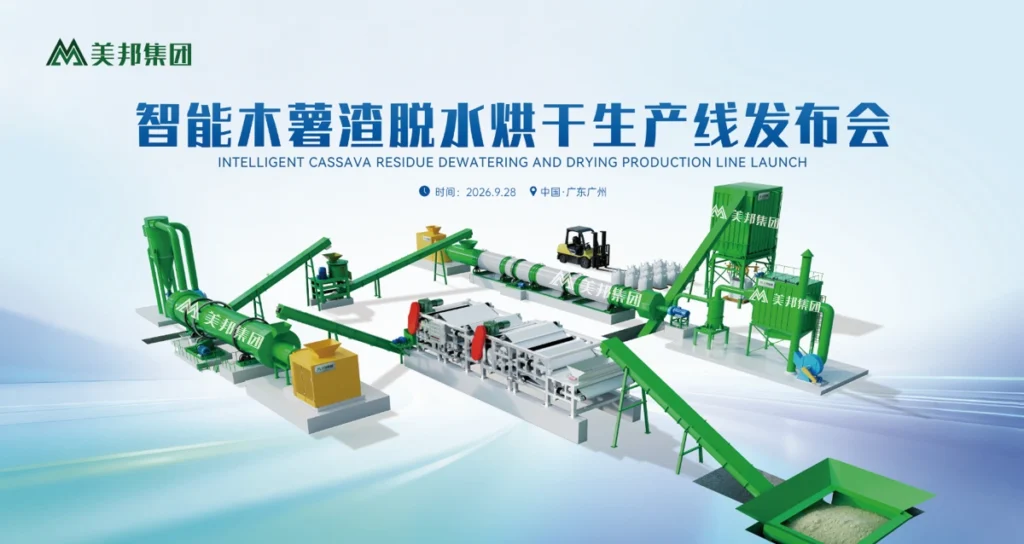
Meibang has developed an intelligent cassava residue dewatering and drying line designed to convert high-moisture cassava residue into a stable, low-moisture finished product.
The complete line integrates mechanical dewatering, two-stage drying and dust removal into a continuous processing system. The finished cassava residue can reach a stable moisture content of around 12%, making it suitable for direct packing, transportation and storage.
1. Line Structure
The intelligent cassava residue dewatering and drying line mainly consists of:
- Screw conveyor feeding system
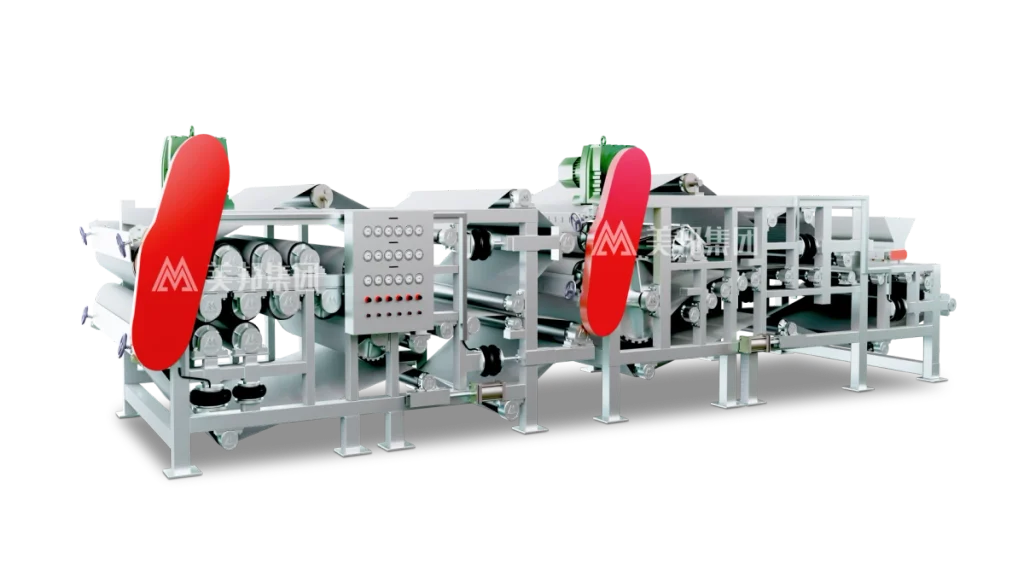
- Dual-motor cassava residue dewatering press
- First three-stage drying system
- First-stage dust removal system
- Conveyor transfer system
- Second three-stage drying system
- Second-stage dust removal system
- Finished product discharge and packing system
The equipment configuration can be customized according to the moisture content, processing capacity and final moisture requirements of the cassava residue.
2. Dewatering Process
Fresh cassava residue normally contains a high amount of water, making direct drying inefficient and costly.
The process therefore starts with mechanical dewatering.
Wet cassava residue is continuously conveyed into the dual-motor dewatering press. The screw pressing system removes a significant amount of free water before the material enters the drying section.
Mechanical dewatering reduces the water load on the dryers and prepares the cassava residue for more efficient thermal drying.
3. First-Stage Drying
After mechanical dewatering, the cassava residue enters the first three-stage drying system through a conveyor.
The first drying system is designed to further reduce the moisture content of the material to around 60%.
Using a multi-stage drying configuration allows the drying process to be carried out progressively rather than relying on a single long drying section.
After the first drying stage, the material passes through a dust removal system.
This step is particularly important because fine cassava residue particles can be generated during drying. Removing dust between the two drying stages helps control dust accumulation and reduces the risk associated with combustible dust during the subsequent drying process.
4. Second-Stage Drying
After dust removal, the partially dried cassava residue is transferred into the second three-stage drying system.
The second drying system continues to remove moisture until the finished product reaches approximately 12% moisture content.
The two-stage drying configuration separates the drying process into two sections, allowing the material to be progressively dried while reducing the overall length and load of a single drying system.
5. Final Dust Removal
After the second drying stage, the finished cassava residue passes through another dust removal system.
The second dust removal process further separates fine particles from the finished material and helps improve the cleanliness and handling conditions of the final product.
The finished cassava residue can then be discharged directly for packing, transportation or storage.
6. Final Product
The final product has a moisture content of approximately 12%.
Compared with wet cassava residue, the dried product is much easier to handle, transport and store. It can also be processed and sold as a dry raw material for downstream applications.
Dried cassava residue is commonly used as a raw material in industries such as:
- Animal feed
- Alcohol production
- Cat litter
- Other biomass and plant-based products
This creates an opportunity for cassava starch factories to go beyond simply disposing of wet residue and instead convert cassava residue into a more valuable commercial product.
7. Complete Processing Flow
The complete process can be summarized as:
Wet Cassava Residue → Screw Conveyor → Dual-Motor Dewatering Press → First Three-Stage Dryer → Dust Removal → Conveyor → Second Three-Stage Dryer → Dust Removal → Finished Cassava Residue → Packing / Storage / Transportation
The system combines mechanical dewatering and thermal drying to provide a continuous solution for large-scale cassava residue processing.
8. Why Use Dewatering Before Drying?
Cassava residue contains a large amount of water. Removing water mechanically before thermal drying is an important part of improving the overall efficiency of the process.
The dual-motor dewatering press handles the initial water removal, while the drying systems are responsible for reducing the remaining moisture to the required final level.
This combination allows each part of the production line to perform its specific function:
Mechanical dewatering removes free water.
The first drying stage reduces moisture progressively.
Dust removal controls fine particles between drying stages.
The second drying stage achieves the final moisture requirement.
Final dust removal prepares the finished product for handling and storage.
9. From Cassava Residue to a Marketable Product
For cassava starch factories, residue management is not only an environmental issue but can also be an opportunity for additional revenue.
Wet cassava residue has a high moisture content and limited storage stability. Transportation is also inefficient because a large proportion of the material being transported is water.
By processing the residue through an integrated dewatering and drying line, the water content can be substantially reduced and the material converted into a dry product with approximately 12% moisture.
The dried product can be packed, transported and stored more conveniently and can enter different downstream markets.
The intelligent cassava residue dewatering and drying line therefore provides cassava starch factories with a complete solution for residue dewatering, drying, dust control and product recovery.