

Intelligent Cassava Residue Dewatering & Drying Production Line
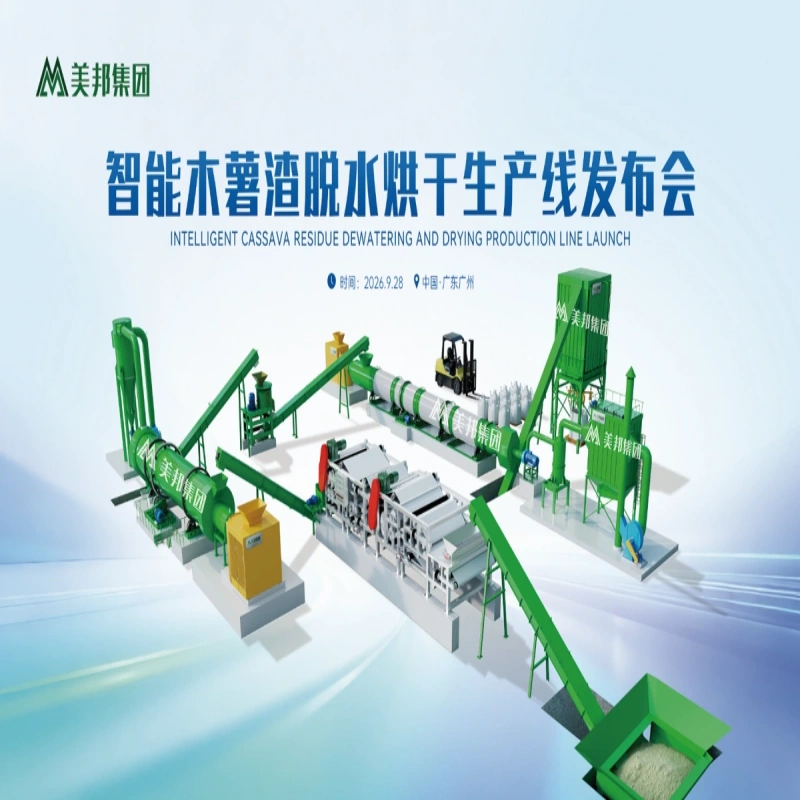
- Integrated dewatering and two-stage drying
- Designed for high-throughput cassava residue processing
- Dual-motor press for efficient dewatering
- Moisture reduced from 65% to 12%
- Dust removal between drying stages
- Customized production capacity and configuration
Description
Intelligent Cassava Residue Dewatering & Drying Production Line
The Intelligent Cassava Residue Dewatering & Drying Production Line is a continuous processing system developed for high-volume cassava starch factories and cassava processing plants.
Instead of relying on a long single-stage drying system, the production line combines mechanical dewatering with two-stage drying and intermediate dust removal. This process reduces the moisture load before thermal drying, shortens the required drying line, and provides better control of dust generated during cassava residue drying.
1. Mechanical Dewatering
Fresh cassava residue is first conveyed by a screw conveyor to the feed inlet of the dual-motor screw press.
The high-capacity screw press performs mechanical dewatering before the material enters the drying system. Depending on the incoming material and operating conditions, cassava residue with an initial moisture content of around 65% can be prepared for the subsequent drying process.
The dual-motor configuration provides high processing capacity and allows the dewatering machine to be customized according to the customer’s required throughput.
Available filter belt widths range from 2.0 m to 3.5 m, with processing capacity of approximately 10–20 m³/h, depending on material characteristics and machine configuration.
2. First-Stage Three-Stage Drying
After mechanical dewatering, the cassava residue enters the first three-stage drying system.
The first drying stage reduces the moisture content from approximately 65% to around 40%. Using multiple drying stages allows the material to be dried progressively rather than relying on one long drying section.
This reduces the moisture load before the final drying process and helps improve the overall efficiency of the production line.
3. Intermediate Dust Removal
After the first drying stage, the partially dried cassava residue passes through a dedicated dust-removal system.
Cassava residue becomes progressively drier during thermal processing, and fine particles or dust may be generated during conveying and drying. Removing accumulated dust between the two drying stages helps reduce the concentration of combustible dust within the production system.
The dust-removal stage is therefore an important part of the production line’s safety and process-control design.
4. Second-Stage Three-Stage Drying
After intermediate dust removal, the cassava residue is conveyed to the second three-stage drying system.
The material is further dried from approximately 40% moisture to around 12% moisture, producing a stable final product suitable for subsequent packaging, storage, and transportation.
Separating the drying process into two stages allows the production line to handle the moisture reduction progressively while avoiding the need for an excessively long continuous drying section.
5. Final Dust Removal and Product Discharge
After the second-stage drying process, the dried cassava residue passes through the final dust-removal system.
The finished material reaches approximately 12% moisture content and can then be conveyed directly to the packaging section for bagging and transportation.
The complete process can therefore be organized as:
Fresh Cassava Residue → Screw Conveying → Mechanical Dewatering → First Three-Stage Drying → Dust Removal → Second Three-Stage Drying → Final Dust Removal → Packaging
Designed for High-Throughput Cassava Processing
The production line is designed for cassava starch factories and processing plants that need to handle large volumes of wet cassava residue continuously.
The front-end dual-motor dewatering machine can be customized according to the required processing capacity. Filter belt widths are available from 2.0 m to 3.5 m, with typical processing capacities ranging from approximately 10 to 20 m³/h.
The final configuration can be adapted according to:
- Cassava residue moisture content
- Required processing capacity
- Target final moisture content
- Available installation space
- Heating system
- Material conveying requirements
- Packaging requirements
Two-Stage Drying for a More Compact Production Line
A conventional approach may require a long drying section to continuously reduce the moisture content from wet cassava residue to the final target.
This production line divides the drying process into two stages, with dust removal between them.
The first stage handles the major moisture reduction, while the second stage completes the drying process. This configuration can significantly reduce the required length of the drying line compared with an equivalent single-stage arrangement.
For large cassava processing plants, the more compact layout can also make equipment arrangement, material conveying, and factory integration easier.
Dust Control and Explosion-Risk Reduction
Dust control is an important consideration when drying biomass materials.
As cassava residue becomes drier, fine particles can be generated during drying, conveying, and handling. If combustible dust accumulates within a drying system, it can increase the risk of dust-related fire or explosion.
For this reason, the production line incorporates dust-removal stages after each major drying section.
The intermediate dust-removal system removes accumulated fine particles before the material enters the second drying stage, while the final dust-removal system handles dust generated during the final drying process.
This process design helps reduce combustible dust accumulation and improves the overall reliability of continuous cassava residue drying.
Actual safety performance and explosion-protection measures should be configured according to the specific material characteristics, plant conditions, applicable local regulations, and the final engineering design.
Key Features
Integrated Process
Combines mechanical dewatering, two-stage drying, dust removal, conveying, and finished-product handling in one production line.
High-Capacity Dewatering
A customized dual-motor screw press handles high volumes of wet cassava residue before thermal drying.
Two-Stage Drying
Progressively reduces moisture from approximately 65% to 40%, and then from 40% to approximately 12%.
Intermediate Dust Removal
Removes fine particles between drying stages to improve dust control and process reliability.
Compact Layout
The two-stage drying configuration can significantly shorten the overall drying line compared with a conventional long single-stage drying arrangement.
Customized Capacity
Dual-motor screw presses can be configured according to the customer’s required throughput, with filter belt widths from 2.0 m to 3.5 m.
Continuous Operation
Designed for cassava starch factories requiring continuous processing and stable high-volume production.
Ready for Packaging
The final product can be discharged at approximately 12% moisture content and sent directly to packaging and transportation.
Typical Technical Parameters
| Parameter | Specification |
|---|---|
| Material | Cassava Residue |
| Initial Moisture | Approximately 65% |
| Moisture After First Drying | Approximately 40% |
| Final Moisture | Approximately 12% |
| Dewatering Equipment | Dual-Motor Screw Press |
| Filter Belt Width | 2.0–3.5 m |
| Dewatering Capacity | Approximately 10–20 m³/h |
| Drying Process | Two-Stage, Three-Stage Drying |
| Dust Control | Intermediate + Final Dust Removal |
| Final Product | Dried Cassava Residue |
| Application | Cassava Starch & Cassava Processing Plants |
A Complete Solution for Cassava Residue Valorization
The Intelligent Cassava Residue Dewatering & Drying Production Line is more than a drying machine. It is an integrated solution for converting high-moisture cassava residue into a transportable and easier-to-handle dried product.
By combining high-capacity mechanical dewatering, two-stage drying, intermediate dust removal, and final product handling, the system is designed to help large cassava processing plants reduce drying-line length while maintaining high processing capacity and reliable continuous operation.
Production line capacity and equipment configuration can be customized according to the customer’s raw material, moisture content, required output, final moisture target, and factory conditions.